



Is It Normal for Them Not to Want to Separate from Us?
“As soon as I leave the room, he starts crying.” “She doesn’t want to stay with anyone but us.” “He used to stay calmly with his grandparents, but now he doesn’t want to leave my side.” “When I drop her off at daycare, she cries profusely.”
These are situations we frequently hear at our child psychology center. And it is understandable that they can cause concern as parents. When our baby cries upon separating from us, clings tightly, constantly seeks us out, or seems unwilling to accept another caregiver, it is easy to think that something is wrong.
But there is something important we must know: separation anxiety in babies exists and, in the vast majority of cases, it is a normal part of development.
In fact, a baby protesting when their primary attachment figure disappears can be an expected manifestation of the development of the attachment bond. As the baby matures, they begin to recognize key figures more clearly and progressively understand that these individuals continue to exist even when out of their visual field. Separation, therefore, can generate distress without necessarily signaling any psychological problem.
The question is not so much asking ourselves, “Does my baby have separation anxiety?”, but rather: Is what they are doing expected for their age, or are we facing an excessively intense, persistent, and limiting reaction?
Does Separation Anxiety in Babies Really Exist?
Yes. However, it is convenient to distinguish between two concepts that are often used interchangeably.
On the one hand, we have developmental separation anxiety, which is a typical response during early childhood. On the other, we find separation anxiety disorder, which is a clinical diagnosis and does not simply equate to a baby crying when their mother or father leaves.
During the first months of life, babies need their caregivers to regulate themselves, feel safe, and meet their basic needs. As they mature, they begin to develop more selective bonds, and their ability to recognize key individuals increases.
Separation anxiety usually becomes particularly evident around 8 months of age and can reach greater intensity during the second year of life. Spanish pediatric literature describes this stage as a regular developmental phase, of variable duration, which typically decreases progressively.
It is then that many parents begin to notice a change: the baby who previously stayed calmly in other people’s arms begins to protest when Mom or Dad leaves.
And this can happen even if the baby had been very sociable up until that point.
It does not mean they have become “dependent,” that we have spoiled them by holding them too much, or that we have done something wrong. Nor does it mean we should avoid separations to spare them distress.
It is part of a developmental process in which the baby begins to distinguish more clearly who their primary attachment figures are and seeks their proximity when needing security.
How to Differentiate Normal Separation Anxiety from a Problem?
This is probably the question families ask us the most.
A baby may cry when their mother leaves the room, cling to her when she tries to walk away, or initially reject an unfamiliar person. All of this can be perfectly expected.
The difference lies mainly in age, intensity, duration, ability to self-soothe, and the impact it has on daily life.
For example, a 10-month-old baby who cries when their mother leaves and then manages to calm down with their grandmother is not the same as a child who experiences disproportionate distress at any separation and whose family systematically avoids normal situations out of fear of their reaction.
We must also take context into account. Fatigue, hunger, illness, changes in routine, starting daycare, a trip, moving, or any major modification in the baby’s life can temporarily increase difficulties during separations.
Therefore, a single episode of crying does not allow us to speak of a disorder.
The Spanish Association of Pediatrics (Asociación Española de Pediatría) indicates that anxiety becomes problematic when its intensity or duration is excessive, or when it significantly interferes with the child’s usual activities.
Separation Anxiety According to Age
Although every baby has their own pace, knowing the general characteristics of each stage can help us better interpret what is happening.
From 0 to 6 Months: We Cannot Yet Speak of Typical Separation Anxiety
During the first months, the baby fundamentally needs the presence and regulation of their caregivers. They may cry when caregivers move away, especially if they are hungry, sleepy, uncomfortable, or need physical contact.
However, during this stage, we are still talking about an attachment system that is in development. Clear behaviors of seeking a specific figure and anxiety in their absence become much more evident later on.
Therefore, if a young baby cries when left in someone else’s arms, we should not automatically interpret that they have “separation anxiety.”
At this age, the most important thing is to respond to their needs, offer contact and security, and progressively foster familiarity with different caregivers.
Between 6 and 12 Months: It Begins to Become More Evident
Starting in the second half of the first year, a much clearer reaction to separation may appear.
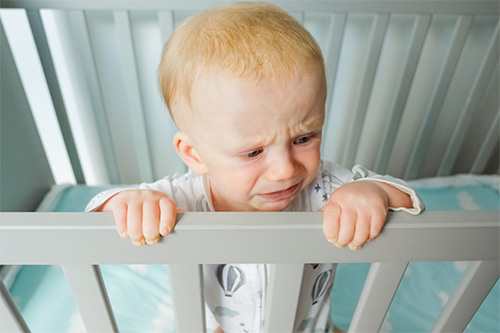
The baby may cry when Mom or Dad disappears from their sight, seek them out by crawling, reach out their arms for them to return, or protest when another person tries to hold them.
Separation anxiety usually becomes especially evident around 8 months. In parallel, the so-called fear or anxiety of strangers may also appear: the baby may seem reserved or cry in front of unfamiliar people, even if they previously allowed anyone to hold them.
It is not necessarily a sign of insecurity. It is part of the process of social differentiation and recognition.
Between 10 and 18 Months: It Can Reach Its Peak Intensity
This is usually one of the stages in which separation anxiety in babies is most apparent.
The baby already has a greater awareness of who their reference figures are, but still possesses few resources to manage the distress experienced when separating from them.
They may cry intensely upon entering daycare, cling to their parents’ legs, protest when parents leave the house, or wake up at night seeking their presence.
Pediatric sources usually place the peak intensity of this stage between 10 and 18 months, with a progressive decrease during the second half of the second year.
This is important because, precisely when the reaction is most intense, it can be easier to think that a problem exists.
However, intensity does not necessarily mean pathology.
A baby can cry a lot and still be well within completely normal development.
Between 18 and 24 Months: Progressively Greater Capacity to Tolerate Separation
As the capacity for comprehension, communication, and self-regulation increases, many children begin to tolerate separations better.
They may still protest, cry, or want Mom or Dad to stay, but they can progressively better understand that the separation is temporary and that their attachment figure will return.
Spanish pediatric documentation notes that around 18 months, separation distress can still be observed, and that by 24 months it has usually decreased, although temporary reactivations may occur—for example, around bedtime.
How to Know If Your Baby Has Separation Anxiety?
Rather than focusing solely on whether they cry, we must observe how, when, and how much that reaction impacts them.
Some common manifestations of developmental separation anxiety include:
- Crying when the attachment figure leaves.
- Trying to follow or crawl after them.
- Searching for them when they disappear from sight.
- Preferring Mom or Dad over other people.
- Protesting when staying with another caregiver.
- Waking up during the night seeking their attachment figure.
- Showing greater difficulty separating when tired, sick, or after routine changes.
All of these behaviors can be part of normal development.
We would be more concerned when the reaction is very intense and persistent for the child’s age, appears in a generalized manner, and begins to significantly interfere with their functioning.
For example, when routine separations systematically become episodes of extreme anguish, when the child fails to calm down after the separation, when there is marked avoidance of age-appropriate situations, or when fear and worry persist disproportionately.
It is in these types of situations that it may be advisable to consult a professional specialized in childhood to evaluate whether we are facing a developmental difficulty that requires guidance or a possible separation anxiety disorder.
How Long Does Separation Anxiety Last?
There is no exact duration that applies to all babies.
Developmental separation anxiety can appear during the second half of the first year, intensify during the second year, and progressively decrease as the child develops greater autonomy and resources to understand and tolerate separations.
Consulted pediatric sources place its typical onset around 8 months and describe a particularly high intensity between approximately 10 and 18 months, although there is significant individual variability.
Therefore, we should not interpret that a baby has a problem simply because they have been crying for several weeks upon separating.
It is more useful to observe their progress:
- Do they need less and less time to calm down?
- Are they progressively accepting other caregivers?
- Can they enjoy themselves after the separation?
- Are goodbyes still difficult, but becoming shorter?
If we observe favorable progress, we are generally dealing with a maturation process.
On the other hand, if the distress remains very intense, becomes generalized, worsens, or begins to significantly limit family, school, or social life, a professional assessment is worthwhile.
Separation anxiety disorder implies something different from developmental anxiety: we speak of an excessive and age-inappropriate fear or anxiety regarding separation from attachment figures, accompanied by various clinical manifestations and a significant impact on the child’s functioning. In children and adolescents, diagnostic criteria also establish a persistence of symptoms for at least four weeks.
Tips for Working on Separation Anxiety in Babies
The good news is that we do not need to “teach” a baby not to miss their parents.
Our goal should not be to ensure they never cry when we leave, but rather to help them experience that they can separate, feel safe during that time, and verify that we return.
1. Anticipate Separations
Even if our baby does not yet fully understand language, we can explain what is going to happen:
“Mommy is going away for a little bit and will come back later.”
“Now you will stay with Grandma, and I will be back after your snack.”
Always using similar expressions helps create predictability. Long explanations are unnecessary; what matters is that our words are simple and consistent with what will actually happen.
2. Avoid Sneaking Away
Sometimes we think that leaving without the baby seeing us will prevent crying. It may work in the short term, but it does not necessarily help them build a predictable experience of separation. A brief, clear, and affectionate goodbye is preferable: we say goodbye, convey security, and leave.
3. Do Not Prolong the Goodbye Indefinitely
When we see our child cry, it is natural to want to hug them more, explain things again, give them another kiss, and delay leaving. However, an overly long farewell can end up increasing tension for both. A brief and consistent ritual is usually easier:
“I love you very much. I am leaving now. I will be back later.”
And then, leave.
4. Practice Small Separations
Especially when the baby is starting to experience separation anxiety, we can take advantage of everyday situations to practice. We can leave them for a few minutes with another trusted adult while we do something in another room. Later, we can progressively increase the time. It is not about forcing long separations, but about offering repeated experiences of separation and reunion.
The Spanish Association of Pediatrics itself recommends progressively encouraging autonomy and carrying out brief separations that can gradually increase in duration.
5. Facilitate the Bond with Other Caregivers
Grandparents, relatives, educators, or other reference figures can also become individuals with whom the baby feels safe. It is positive for the baby to experience that they can be well cared for by different people, without that implying a replacement of their primary attachment figures.
6. Maintain Routines
Babies benefit especially from predictability. Keeping relatively stable schedules and rituals for sleeping, eating, playing, or separating can help them anticipate what will happen. During times of major changes, such as starting daycare, we can try to keep other family routines as stable as possible.
7. Validate Their Emotions Without Transmitting Alarm
We can say:
“I know you want me to stay. It’s hard for you when Mommy leaves. I understand. Grandma will be with you, and I will come back later.”
We do not need to convince them that “nothing is wrong” when clearly, to them, something is happening. Validating does not mean confirming a danger exists. It means acknowledging the emotion while we maintain security:
“I understand that you are sad. You are safe. I will come back.”
8. Mind Our Own Emotional State
Babies are particularly sensitive to their caregivers’ cues. If we say goodbye with great distress, guilt, or insecurity, the separation may be more difficult. This does not mean we should hide our emotions or that we are to blame for the baby crying. Simply, we can try to convey a coherent message:
“I know this can be hard, but I trust that you will be fine and I will return.”
When Should We Consult a Professional?
Separation anxiety in babies is usually a normal part of development and, on its own, is not a cause for alarm. Even so, it may be advisable to seek professional guidance when we observe that:
- The reaction to separations is extremely intense and persistent.
- The child fails to regain composure after separating.
- The difficulty significantly interferes with daycare or family life.
- The family systematically begins to avoid separations.
- The fear appears in different contexts and not solely with a specific person or situation.
- The intensity of the reaction increases rather than progressively decreases.
- There are other significant changes in behavior, sleep, eating, or emotional regulation.
In these cases, a psychological evaluation does not mean we are “labeling” the baby or that a disorder necessarily exists. Often, consulting simply serves to understand what is happening, adjust adult responses, and better accompany a specific stage of development.
The Spanish Association of Pediatrics notes that anxiety disorders should be evaluated especially when anxiety is intense, persistent, or interferes with the child’s daily activities.
Separation Anxiety Does Not Mean You Did Something Wrong
One of the concerns we encounter most in consultations is guilt:
- “Did we hold him too much?”
- “Did we get her too used to us?”
- “Have we done something wrong?”
In the majority of developmental situations, the answer is no.
A baby seeking their parents, protesting when separated, or needing their presence to calm down is part of their socio-emotional development. The search for proximity toward attachment figures serves an adaptive function: when the baby feels insecure, tired, frightened, or overwhelmed, they seek out the person who provides security and regulation.
Our goal is not to make a baby “not need” their parents. On the contrary: the security found in their reference figures is precisely one of the foundations from which they can gradually develop autonomy.
Therefore, when talking about separation anxiety in babies, it helps to reframe the question. It is not merely:
“How do I get them to stop crying when I leave?”
But rather:
“How can I accompany them so they learn, step by step, that we can separate and find each other again?”
And therein lies one of the keys. Tolerating separation is learned through repeated experiences of security, predictability, and reunion: saying goodbye, leaving, being cared for by other trusted individuals, verifying that we return, and living through it again.
Little by little, what may seem like a overwhelming separation today becomes a familiar experience.
At Psicología Infanto-Juvenil Mallorca, we accompany families through this process, helping them differentiate between what is part of normal development and what may require more specific attention. Because understanding what is happening is often the first step toward accompanying our children with greater calmness, security, and confidence.